They Post Picks. We Log Results. 7–2 Bowl Run | 25–12 Since Dec 19
Going into this slate, Unc’s Trend Plays were 19–10 since Friday, December 19.
That run wasn’t built on volume. It wasn’t built on heaters. It was built on selectivity, timing, and structural patience.
Bowl season didn’t interrupt that.
It extended it.
The bowl run actually started Friday night with FIU / UTSA OVER 57.5, a clean acceleration read that cashed exactly where the market lagged. That win set the tone, not because it added confidence, but because it confirmed the framework heading into the weekend.
What followed only reinforced it.
Across the slate, eight bowl positions were logged.
Six wins. Two losses. Logged cleanly.
Alongside those positions, 77 quantified trend signals were published in real time covering totals, sides, pace environments, rest asymmetries, and game-state sensitivities. This wasn’t a handful of opinions cherry-picked after the fact. It was a full framework operating in public, with volume kept intentional and filters kept tight.
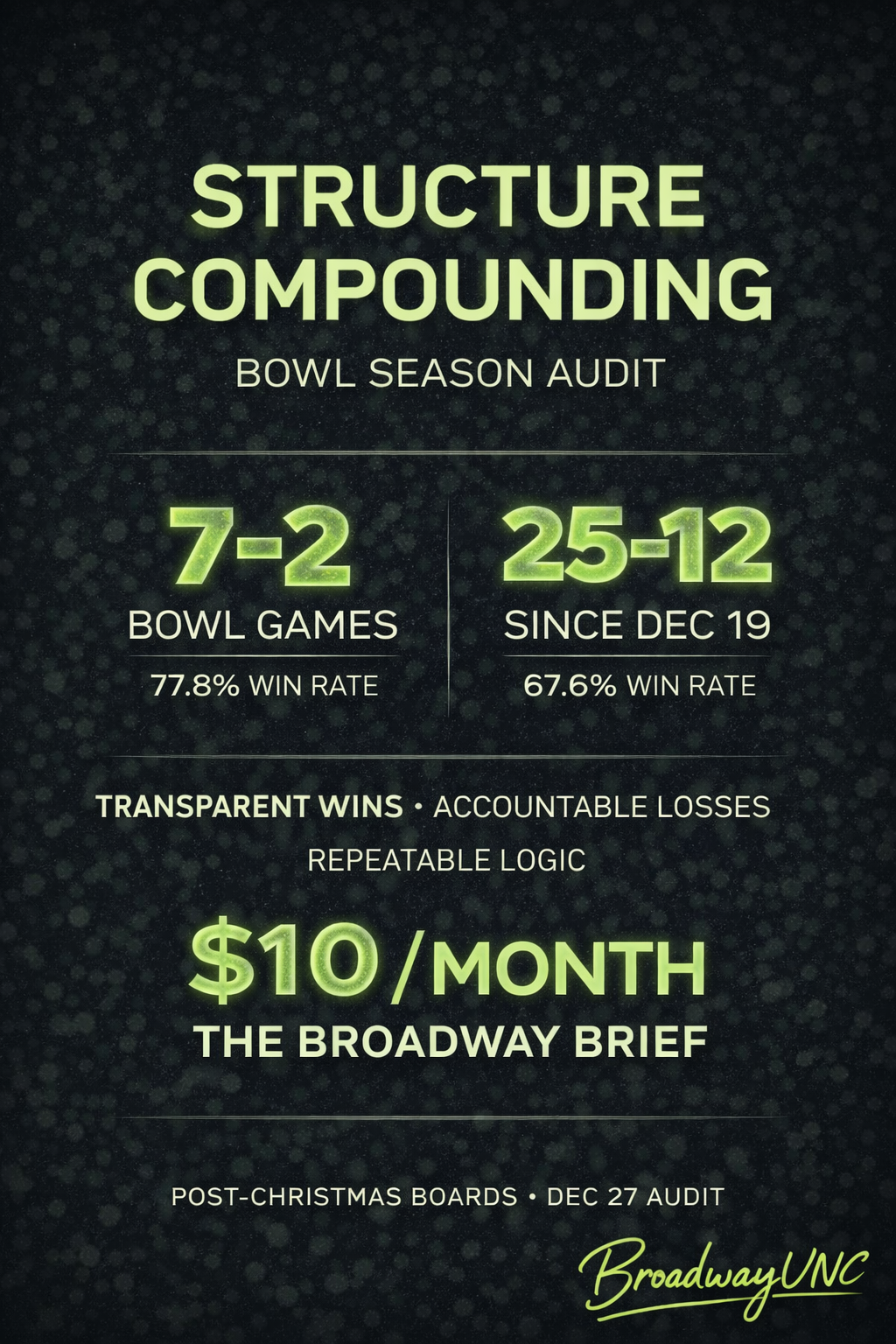
Including Friday night, that puts the bowl run at 7–2 and moves the broader stretch to 25–12 overall.
Post-Christmas boards are where discipline gets stress-tested first. Narratives reset faster than numbers. Pricing lags just enough to invite overreach, and that’s usually where damage happens.
We didn’t overextend.
Volume stayed intentional. Filters stayed tight. The result was exactly what the framework is designed to produce, a profitable card with losses that came from execution breaks and early game-state shocks, not misreads.
No excuses.
No reframing.
Some edges cleared exactly as modeled. Others ran into variance that erased margin before structure could assert itself. That’s part of the game, and it gets logged the same way every time.
Context matters.
25–12 since December 19.
7–2 on bowl games.
That isn’t momentum chasing.
That’s structure compounding.
This recap isn’t spin.
It’s an audit.
And that’s the point. Wins, recaps, and jam-packed trend infrastructure delivered daily, transparently, and accounted for, all in one place. For $10 a month, there isn’t another product in this space that consistently provides all three without hiding from losses or chasing noise.
Below is the breakdown.
✅ WINS: STRUCTURE HELD
🔥 Military Bowl
East Carolina vs Pittsburgh
UNDER 53 | ✅ WIN
Textbook late-season compression. Extended rest and an early kickoff didn’t accelerate pace. They suffocated it. Field position mattered. Scripts stayed protected. Possessions shortened quietly.
Even brief third-quarter chaos didn’t break structure. ECU answered immediately, reclaimed control, and never allowed elasticity to surface.
Edge: Early kickoff plus long rest equals pro-clock environment
Result: UNDER cleared by a mile
🔥 Wasabi Fenway Bowl
Army -7.5 vs UConn
✅ WIN
This followed the option-rest profile exactly. UConn’s layoff showed up in reads, not tackles. Once Army gained leverage, possessions disappeared and the math flipped fast.
Edge: Option offense versus long-rest timing decay
Result: Comfortable cover
🔥 Pop-Tarts Bowl
BYU -3.5 vs Georgia Tech
✅ WIN
BYU absorbed early variance, stayed composed, and separated late through discipline instead of tempo. Georgia Tech never fully reset after perception inflation.
Edge: Short-favorite role stability plus neutral-site hangover
Result: Structure wins late
🔥 Arizona Bowl
Miami (OH) vs Fresno State
UNDER 41.5 | ✅ WIN
This never flirted with variance. Possessions were capped from kickoff. Fresno State dictated field position and banked points instead of chasing them.
Edge: Full-game clock control plus suppressed passing
Result: UNDER wire to wire
🔥 New Mexico Bowl
North Texas vs San Diego State
OVER 52.5 | ✅ WIN
This wasn’t bowl caution. It was tempo snapback. North Texas came off suppression and reverted violently. Late kickoff and extended rest showed up as defensive lag immediately.
Edge: Post-suppression tempo rebound
Result: OVER obliterated
🔥 Gator Bowl
Missouri vs Virginia
UNDER 44.5 | ✅ WIN
Virginia erased an entire quarter with one drive and never released control. Missouri never forced pace. Totals don’t survive that profile.
Edge: Late-season control plus conservative coaching response
Result: UNDER with no drama
❌ LOSSES: PROCESS VS GAME STATE
⚠️ Pinstripe Bowl
Clemson -2.5 vs Penn State
❌ LOSS
The edge required thin efficiency. Clemson never generated it. Penn State played clean, won leverage moments, and stretched margin with a single explosive.
Failure Point: Execution gap at a short number
Note: Trend edge erased by efficiency separation
⚠️ Texas Bowl
Houston vs LSU
UNDER 42.5 | ❌ LOSS
A 99-yard kickoff return and early score-state explosion broke the profile immediately. Once clean game state disappeared, protection mode never returned.
Failure Point: Non-offensive touchdown plus forced response offense
Note: Early variance nuked compression assumptions
📌 BIG-PICTURE TAKEAWAYS
• Early kickoffs paired with long rest continue to suppress totals
• Option teams punish layoff-induced timing decay
• Suppressed offenses still revert violently with pace triggers
• Short numbers remain execution-sensitive in neutral environments
• Game-state shocks, not misreads, accounted for losses
• Structure held. Margin tolerance didn’t
This wasn’t a perfect slate.
It was a process-consistent one.
Transparent wins.
Accountable losses.
Repeatable logic.
That’s the edge.
That’s why the framework doesn’t change.
On to the next slate.